
Evidence-based interviewing is a structured way to hire using observable, job-related signals—like defined competencies, consistent questions, documented examples, and scored rubrics—instead of intuition. For small businesses, it reduces mis-hires by making interviews repeatable and easier to compare. Start with a competency rubric, use structured interviews, capture evidence in scorecards, and review results with a short, consistent debrief.
What evidence-based interviewing means (and why SMBs benefit fast)
In a large company, a messy interview process can be hidden by volume, extra checks, and specialized HR support. In a small business, one wrong hire can immediately show up as missed deadlines, customer issues, or leadership time spent “repairing” the role. Evidence-based interviewing is a practical, data-driven interviewing approach: you decide up front what success in the job looks like, ask candidates questions designed to surface proof, document what you heard and observed, and score candidates against a shared rubric so decisions are comparable.
Evidence-based vs. “going with your gut”
“Gut feel” usually means the interview is an unstructured conversation. Different candidates get different questions, and interviewers remember different things. The debrief becomes a debate about impressions: “I just didn’t feel confident” or “They seemed smart”. The problem isn’t that humans have instincts—the problem is that instincts are hard to compare and hard to audit later. Evidence-based interviewing keeps human judgment (you still have to decide) but grounds it in the same inputs every time: the same competencies, the same prompts, and the same scoring rules.
The SMB advantage: you can standardize quickly
Small teams often worry that “structured” means “bureaucratic.” In practice, an evidence-based hiring process can be lighter than an ad-hoc process because it reduces rework: fewer re-interviews because someone forgot to ask about a must-have skill, fewer late-stage surprises, and less time spent arguing in the debrief. The key is to standardize only what matters: the job’s success criteria, the questions that test them, and the way you capture evidence. Everything else (rapport, follow-ups, and the candidate experience) can still feel human.
What counts as “evidence” in an interview (5 types, with SMB examples)
Evidence doesn’t mean “data science.” It means you collect signals that are (a) related to the job, (b) observable or documentable, and (c) comparable across candidates. For SMB teams, the fastest win is agreeing on what evidence looks like before you start interviewing—so you’re not improvising standards after you’ve met someone you like.
1) Defined competencies (the target you’re aiming at)
Competencies are the few capabilities that drive success in the role. They’re the foundation for a structured interview workflow for SMBs because they let you map each question and each score to a specific “thing we’re assessing.” Example (SMB Customer Support Lead): Customer empathy, Written clarity, De-escalation, Operational ownership, Learning speed. If your competencies are vague (“good communicator”), you’ll get vague evidence. If they’re measurable (“writes concise customer updates that reduce follow-up”), you’ll collect comparable proof.
2) Structured questions mapped 1:1 to those competencies
A structured question isn’t a trick question. It’s a consistent prompt that increases the chance you’ll hear job-related evidence. For example, to assess operational ownership you might ask: “Tell me about a recurring issue you fixed end-to-end. How did you detect it, what changed, and how did you measure that it stayed fixed?” Everyone gets the same prompt, and interviewers know what to listen for (detection method, scope, stakeholders, measurement). If you want help turning competencies into consistent prompts, Hirero’s guide generation features align with the workflow described in Creating Effective Interview Guides: A Step-by-Step Template for Recruiters.
3) Work samples (small, role-relevant proof)
A work sample is evidence because it shows what the candidate can produce in a constrained, job-like scenario. Keep it short and directly relevant. Examples SMBs can run: (a) a Support candidate writes a 6–8 sentence customer reply to a tricky ticket; (b) a Sales candidate runs a 10-minute discovery role-play with a fixed prompt; (c) an Ops candidate reviews a simple spreadsheet and flags errors plus next steps; (d) an Engineer candidate reviews a small code snippet and explains tradeoffs. The goal isn’t to “trap” candidates—it’s to get observable output you can score consistently.
4) Structured notes (so evidence survives the debrief)
Notes become evidence when they’re tied to a competency and written as observable facts. Compare: (weak) “seems like a great culture fit” vs. (evidence) “When asked about a cross-team conflict, described clarifying goals with Marketing, proposed two options, aligned on one, and documented handoffs; no blaming language; followed up with a written recap.” In SMBs, this is also a resilience tactic: if the decision maker is pulled away, your process doesn’t collapse because the evidence is documented clearly enough for others to review.
5) Evidence-backed scorecards + decision rules (so choices are comparable)
A score without a reason is just a number. An evidence-backed scorecard forces a short rationale: “Rated 4/5 on De-escalation because they described using a calm reframe, offered two options, and prevented churn in a similar scenario; work-sample reply was concise and acknowledged the customer’s frustration.” Pair that with a simple rule such as: no hire if the candidate is below 3/5 on any must-have competency. If you want a deeper walkthrough of scoring mechanics and pitfalls, this pairs well with the Hirero guide on objective interview scorecards.
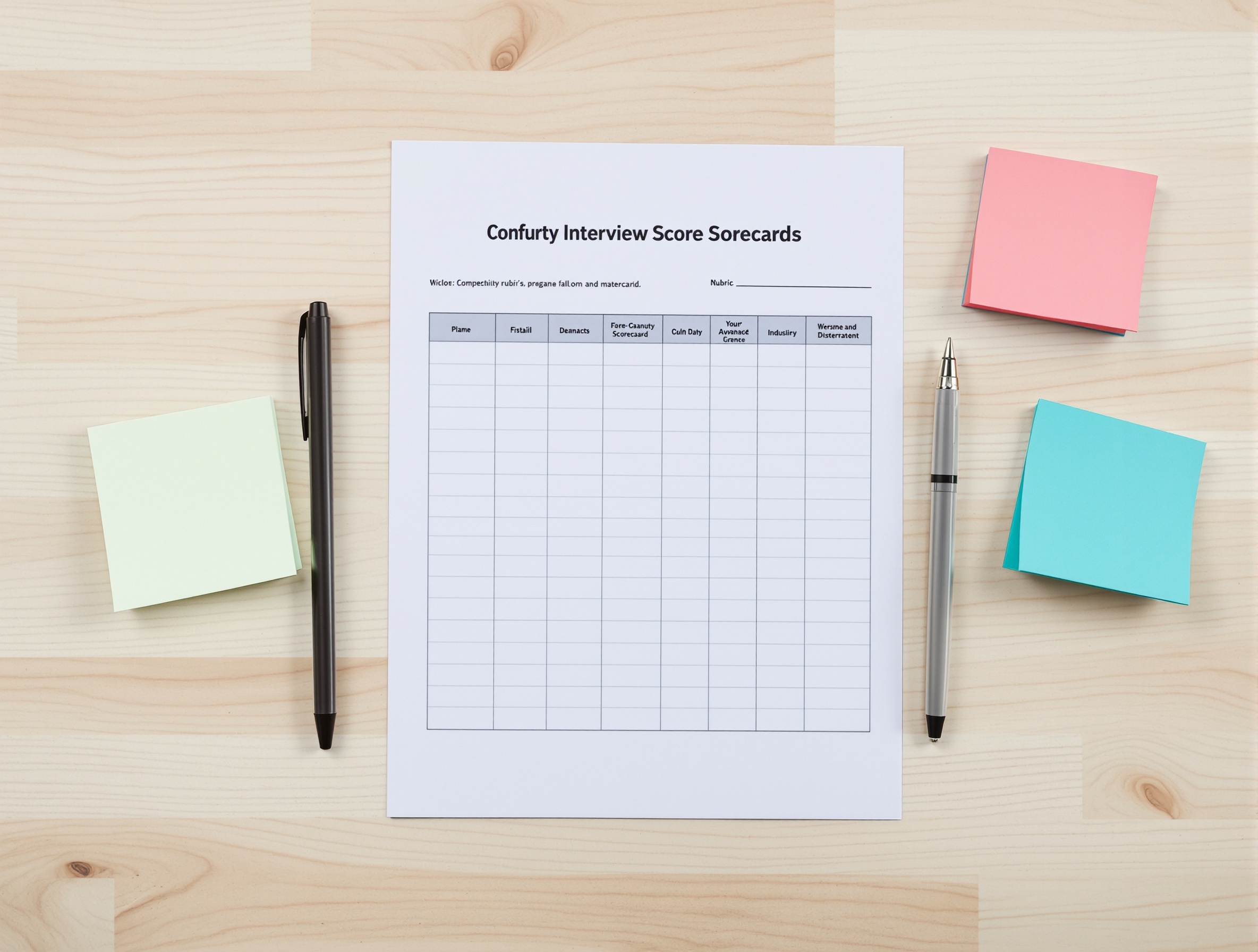
A step-by-step evidence-based interview workflow for small teams (7 steps)
This workflow is designed to be repeatable with limited bandwidth. The principle is simple: define → collect → score → decide → learn. Each step below includes concrete outputs (a rubric, a guide, a scorecard, a debrief rule) so the process doesn’t rely on one person’s memory.
Step 1: Convert the job description into 5–8 measurable competencies
Start from the job description, but don’t stop at responsibilities. Ask: “What would a strong person do repeatedly in their first 90 days?” Then translate that into competencies you can observe. A practical method is to take each top responsibility and rewrite it as a capability. Example: Responsibility: “Own monthly close reporting.” Competency: Operational ownership (can define a process, identify failure points, and improve it). If you need to tighten the JD first, use a structured JD checklist like this small business job description template so your competencies aren’t built on a vague role definition.
- Keep it to 5–8 competencies so the team can remember them and score consistently.
- Separate “must-have” competencies from “nice-to-have” competencies (this will power your decision rule later).
- Avoid proxies like “top school” or “years of experience” as competencies; those are background variables, not job behaviors.
- Write each competency as an observable capability (what they do), not a personality trait (who they are).
Step 2: Define what “good” looks like (behavioral anchors)
Behavioral anchors are short descriptions of what different score levels look like in practice. This is where evidence-based interviewing becomes real: two people can disagree about whether an answer was “good,” but they can agree whether it matches a written anchor. For SMBs, anchors also prevent over-rewarding confidence. A candidate who tells stories smoothly isn’t necessarily the one who will execute well in your environment. Anchors force the interviewer to check for substance: ownership, tradeoffs, measurement, and learning.
Step 3: Build a structured interview plan (stages + owners)
A structured interview workflow for SMBs is mainly about preventing overlap. If three interviewers all ask the same generic questions, you burn time and still don’t get enough evidence on the role-critical competencies. Instead, assign each stage a purpose and a small competency set. Example for a 3-stage process: Stage 1 (screen): must-have basics + motivation; Stage 2 (role interview + work sample): role competencies; Stage 3 (final): collaboration + operating style + risk review.
| Process option | Best for | Stages (example) | Tradeoffs / risks to watch |
|---|---|---|---|
| 2-stage (lean) | High-volume hourly roles, urgent backfills, early-stage SMBs with very limited bandwidth | 1) Structured screen 2) Role interview + short work sample | Higher risk if multiple stakeholders need buy-in; must be strict about competency mapping to avoid missing critical evidence |
| 3-stage (standard SMB) | Most SMB professional roles (sales, support lead, ops, marketing, finance) | 1) Structured screen 2) Role interview + work sample 3) Final hiring manager / cross-functional interview | Requires coordination; watch for stage overlap and “moving the goalposts” late |
| 4-stage (selective) | Senior roles or roles with high compliance/safety risk | 1) Screen 2) Role interview 3) Work sample/panel 4) Final decision interview | Candidate drop-off risk; needs very clear communication and fast scheduling to avoid slow time-to-hire |
Step 4: Generate interview questions that map 1:1 to competencies
Now you build (or generate) a guide where every question is there for a reason. The easiest way to keep this tight is to use a simple mapping rule: one primary question per competency, plus 2–3 follow-ups that force specifics. For behavioral questions, consider a consistent structure: situation, actions, stakeholders, tradeoffs, measurement, and learning. For SMB environments, add one follow-up about constraints: “What did you do when you didn’t have enough resources/time?” That often separates candidates who operate well in smaller teams from those used to large-company support functions.
- Primary question: tests the competency directly (behavioral or situational).
- Evidence follow-ups: “What did you do?” “What did you decide not to do?” “How did you measure success?”
- Signal clarifiers: probe scope, difficulty, and the candidate’s actual contribution (not the team’s).
- Consistency note: keep the core prompt identical across candidates; vary only the clarifiers.
Step 5: Capture evidence during the interview (notes that survive the debrief)
A practical standard for evidence notes: write down the claim, then the proof. The claim is the competency you’re assessing (for example, “stakeholder management”). The proof is what they did and what happened. If you can’t write the proof, you shouldn’t score it highly. This also reduces the halo effect (one great story inflating all scores) because you’re forced to collect separate evidence for each competency. For small businesses, where a single interviewer may cover multiple competencies, this discipline is what keeps your scores meaningful.
Step 6: Score with an evidence-backed scorecard (and avoid common scoring errors)
Scorecards make your interviewing evidence usable. But only if you score the same way every time. A few SMB-specific pitfalls to avoid: (1) score inflation (everyone is a 4/5 because you don’t want conflict in debrief); (2) recency bias (the last candidate seems best because they’re freshest); (3) over-weighting “polish” (a smooth communicator outscoring a better operator). Countermeasures are simple: fill in the scorecard immediately after the interview (before talking to other interviewers), require a one-sentence evidence rationale per score, and keep “overall recommendation” separate from competency scoring until the end.
Step 7: Run a consistent debrief and decision rule (hire/no-hire)
Debriefs drift when they’re unstructured: the loudest voice wins, or the team gets stuck on one concern without checking whether it’s job-critical. A structured debrief is short, evidence-focused, and ends with a clear outcome. The simplest method is to review competency by competency, starting with must-haves. Each interviewer reads out (a) their score, (b) the evidence they recorded, and (c) their top risk/unknown. Only after reviewing all must-haves do you discuss overall recommendation. This keeps the discussion anchored to the same evidence set rather than personal preference.
Decision rules that keep SMB hiring fast (examples)
- Must-have threshold rule: no hire if below the minimum bar on any must-have competency (for example, < 3/5).
- Evidence requirement rule: no “strong no” or “strong yes” without at least one concrete example tied to a competency.
- Unknowns rule: if the debrief lists a critical unknown, decide the fastest evidence method (targeted follow-up, reference check, short work sample) and who owns it.
- Tie-breaker rule: when two candidates are close, prefer the one with stronger evidence on the highest-leverage must-have for your business (often ownership/autonomy in SMB roles).

Templates you can copy/paste: rubric, scorecard, and a 15-minute debrief agenda
These templates are intentionally lightweight so a small business can run them without an HR operations team. Treat them as defaults: start here, run a few hiring cycles, then adjust based on what predicts success in your environment. That “learning loop” is what turns evidence-based hiring into hiring intelligence over time.
Template 1: Competency rubric (with example behavioral anchors)
How to use: pick 5–8 competencies, mark 2–3 as must-haves, and write anchors for 2/5, 3/5, and 5/5. If you only do one thing, do this—because it drives your question design and your scoring consistency.
| Competency (mark must-have) | 2/5 anchor (weak evidence) | 3/5 anchor (meets bar) | 5/5 anchor (strong evidence) |
|---|---|---|---|
| Operational ownership (Must-have) | Describes tasks but not end-to-end ownership; unclear how issues were detected or prevented | Can explain a process they owned, common failure points, and a basic improvement they drove | Builds or improves systems proactively; defines metrics, documents process, and reduces recurring issues measurably |
| Communication (Must-have) | Answers are hard to follow; misses context; doesn’t adapt message to audience | Explains decisions clearly with basic structure; adjusts detail level for stakeholders | Communicates crisply under pressure; writes/recaps decisions; prevents misalignment across teams |
| Problem solving | Jumps to solutions without clarifying; limited tradeoff thinking | Clarifies constraints; evaluates a few options; explains rationale | Frames problems clearly; tests assumptions; considers second-order effects; learns and iterates |
| Collaboration | Blames others; avoids conflict without resolution | Works cross-functionally with basic alignment and follow-through | Builds trust, negotiates tradeoffs, and resolves disagreements with clear next steps |
Template 2: Interview scorecard (with evidence prompts)
How to use: the interviewer fills this out immediately after the interview, independently. In the debrief, they read their evidence and scores rather than re-telling the whole conversation. This is the heart of an evidence-based hiring process because it standardizes what “a good interview” produces: comparable evidence plus a defensible recommendation.
| Field | What to write | Evidence prompts (use as follow-ups next time) |
|---|---|---|
| Competency ratings (1–5) | One rating per competency assessed in this interview | What did they do personally? What was the impact? What constraints did they face? |
| Evidence notes | Bullet-style facts tied to each competency (examples, actions, results) | What changed because of their actions? How do they know it worked? |
| Work sample result (if used) | What they produced + how it met the rubric | What would you ask them to improve if hired? |
| Risks / unknowns | Specific concerns and what evidence is missing | What question or reference check would reduce this risk? |
| Recommendation | Hire / No hire / Hold (with reason tied to must-haves) | Did they meet the minimum bar on must-have competencies? |
Template 3: 15-minute structured debrief agenda (consistent decisions)
How to use: run the same agenda every time, even if only two people attended interviews. Consistency is what makes your evidence-based interview workflow scalable as you hire more roles.
- 30 seconds: restate the role and the 2–3 must-have competencies (so you don’t debate the wrong thing).
- 8 minutes: review must-have competencies one by one. Each interviewer shares score + evidence sentence + any missing evidence.
- 3 minutes: review nice-to-haves and team considerations (still tied to evidence).
- 2 minutes: discuss top risks/unknowns and whether they are addressable (follow-up, reference check, work sample).
- 1–2 minutes: decision using the rule (hire/no-hire/hold). Document the reason in one sentence.
Metrics: a lightweight quality-of-hire dashboard for small businesses
Quality of hire metrics for a small business should be easy to capture, tied to decisions you can actually change, and stable enough to compare across hiring cycles. You don’t need a complex model. You need a feedback loop that answers two questions: (1) Are we collecting consistent evidence? (2) Does that evidence predict early success in our environment?
Leading indicators (process health): are we interviewing consistently?
Leading indicators are useful because they show problems while you’re still hiring—when you can fix them. For example, if one interviewer’s scores are always higher than others, your rubric anchors might be unclear (or that interviewer needs calibration). If your pass-through rate from screen to role interview is extremely low, your screen criteria may not match the role evidence you need—or your sourcing pool isn’t aligned. These are “quality of evidence” metrics, not just pipeline metrics.
| Metric | What it tells you | What to do if it looks off |
|---|---|---|
| Stage pass-through rate (by role) | Whether screens and interviews are aligned to the same competencies | If too low: tighten role definition, adjust screen questions, review sourcing criteria |
| Interviewer score variance | Whether rubric anchors are clear and applied consistently | Run a 15-minute calibration: compare evidence sentences for the same competency and align on anchors |
| Time-to-decision (after final interview) | Whether evidence is sufficient to decide quickly | If slow: add evidence prompts, improve scorecard completeness, enforce debrief agenda |
| “Unknowns per finalist” count | Whether your process is surfacing key risks early | If high: add a targeted follow-up question or a short work sample for that competency |
Lagging indicators (outcomes): did our interview evidence predict success?
Lagging indicators close the loop. They don’t need to be perfect; they need to be consistent. A simple SMB approach is to run a 60- or 90-day check-in where the hiring manager answers a short set of questions tied to the original competencies: “Is the person meeting expectations on Operational ownership?” “How independently are they operating?” “What’s the biggest gap vs. what we expected from the interview evidence?” Over time, you’ll see which competencies (and which interview prompts) actually predict performance in your business.
- 30/60/90-day ramp: define one or two role-specific “early wins” and whether they happened (yes/no plus notes).
- Manager satisfaction at 60–90 days: a simple rating with one sentence of evidence (avoid vague “great hire”).
- Early retention / expectations met: whether the employee is still in role and meeting expectations at 90 days.
- Candidate experience notes: did structure improve clarity and speed, or did it feel repetitive?

Where AI fits in evidence-based hiring (and where to be careful)
AI can support an evidence-based hiring process when it makes your workflow more consistent—especially for small teams that struggle with time. The safest, highest-leverage uses are “process standardization” tasks: generating structured interview guides from competencies, supporting consistent first-round screens, and capturing structured evidence for scorecards. Hirero is positioned as a hiring intelligence platform for recruiters and SMB teams, with features that support interview guide generation, AI-powered interview screening, and evidence-backed interview scorecards—so the process outputs (guides, screening consistency, scorecards) can stay connected instead of living in scattered docs.
Good uses of AI: standardize screens, guides, and evidence capture
Think of AI as a consistency layer, not a decision maker. Examples that fit an evidence-based interviewing workflow: (1) turning your competency rubric into an interview guide with mapped questions and follow-ups; (2) running a consistent first-round screen so every candidate is evaluated against the same core criteria; (3) converting interview notes into structured, competency-tagged evidence prompts so interviewers don’t forget to document the “why” behind a score. These uses help a small business collect comparable evidence without adding headcount or extra meetings.
Where AI can go wrong: bias, proxies, and false certainty
AI outputs can create a feeling of certainty that isn’t warranted—especially if the inputs are messy (unclear competencies, inconsistent notes, or biased historical patterns). The biggest risk isn’t that AI “adds bias” in an abstract way; it’s that teams stop checking evidence and start trusting shortcuts. If you use AI in screening or scorecard support, keep the human decision rule explicit, and audit what “signals” the system is relying on. For a practical checklist and examples of proxy variables to avoid, see Hirero’s guide on how to reduce bias in hiring with AI.
Next steps: operationalize the “hiring intelligence loop” in Hirero (in a week)
Evidence-based interviewing works best when the artifacts stay connected: the job definition informs the competencies, competencies generate the interview guide, interviews produce structured evidence, and scorecards feed consistent debrief decisions. Hirero’s positioning as a hiring intelligence platform maps to that loop by combining guide generation, screening support, and evidence-backed scorecards in one workflow. Here’s a practical rollout plan that fits a small team’s calendar.
- Day 1: Finalize the role definition and 5–8 competencies (use your JD + the rubric template above).
- Day 2: Build a structured interview plan (2–3 stages) and assign owners for each competency.
- Day 3: Create or generate structured interview guides so every interviewer knows the exact questions and follow-ups to use.
- Day 4: Standardize the first-round screen for consistency (and decide what evidence must be captured to pass).
- Day 5: Launch evidence-backed scorecards and a 15-minute debrief agenda; set a recurring 30/60/90-day quality check-in for the role.
If you already have a recruiting motion in place, treat this as an upgrade rather than a rebuild: keep your current stages, but tighten the “evidence contract” in each one. For example, your screen call might already exist—just add a must-have competency checklist and require interviewers to record evidence sentences. Your hiring manager interview might already be on the calendar—just map it to 2–3 competencies and use a scorecard. Small changes like this are often enough to make hiring decisions based on evidence instead of memory.
FAQ: Evidence-based interviewing for small businesses
What is evidence-based interviewing (and how is it different from going with your gut)?
Evidence-based interviewing is a structured way to hire using observable, job-related signals—like defined competencies, consistent questions, documented examples, and scored rubrics—instead of intuition. “Going with your gut” tends to rely on unstructured conversation and vague impressions, which are hard to compare across candidates. For small businesses, evidence-based interviewing makes decisions repeatable and easier to defend and improves learning over time because you can connect interview evidence to post-hire outcomes.
What evidence should interviewers capture during interviews?
Capture evidence that can be verified and compared: (1) specific examples the candidate describes (what they did, what changed, what results), (2) observed behaviors in the interview (clarifying questions, structured thinking, communication), (3) work-sample output (a short exercise, writing sample, role-play notes), (4) structured notes tied to the competency being assessed, and (5) a score with a brief rationale that references the example or observation—not personality judgments.
What should be included in an interview scorecard to make it objective?
An objective scorecard includes: the competencies being assessed, clear rating scales (for example 1–5) with behavioral anchors for what “strong” and “weak” look like, evidence prompts ("What did they do?" "What was the impact?"), space for risks/unknowns, and a decision field (hire/no-hire) tied to a rule (such as minimum score on must-have competencies). The key is that every rating must be backed by a concrete example, observation, or work-sample result.
How do small businesses create a structured interview process without adding lots of stages?
Start small and standardize: define 5–8 competencies from the job description, assign each interview stage a purpose (screen, role skills, team fit/values), use the same questions for all candidates, and score each stage with a short rubric. Many SMBs can run a strong process with 2–3 stages total: a consistent first-round screen, a role-focused interview (often with a work sample), and a short final decision interview.
How many interviews should a small business do before making an offer?
Many small businesses can make a confident decision with 2–3 interviews when each stage is structured and mapped to competencies. Add stages only when they reduce a known risk (for example, a short work sample to validate writing or problem-solving). If you keep adding interviews because the team “still isn’t sure,” that usually signals unclear competencies, weak scoring anchors, or inconsistent debriefs—not a need for more stages.
Which hiring metrics matter most for quality of hire in a small business?
Focus on a small set you can actually maintain: leading indicators like pass-through rates by stage, interviewer score variance, and time-to-decision; and lagging indicators like 30/60/90-day ramp (role-specific), manager satisfaction at 60–90 days, and early retention (for example, still employed and meeting expectations at 90 days). The goal isn’t perfect analytics—it’s a feedback loop that shows whether your interview evidence predicts success.
Can AI help with evidence-based hiring without increasing bias?
AI can support evidence-based hiring when it standardizes process work (generating structured interview guides, summarizing structured notes into scorecard-ready evidence, and keeping screening consistent). To avoid increasing bias, use guardrails: keep competencies job-related, avoid proxy variables, review outputs for fairness, document decision rules, and ensure humans make final decisions. Pair AI with structured interviews and a bias-reduction checklist, like the one in the guide on how to reduce bias in hiring with AI.
Put evidence-based interviewing on autopilot (without adding stages)
If you want a practical way to run structured screens, generate competency-mapped interview guides, and capture evidence-backed scorecards in one place, explore Hirero’s hiring intelligence workflow. Start by implementing the rubric + scorecard templates from this guide in your next role, then track a small set of quality signals at 30/60/90 days to improve hiring over time.